
Automated Machine Vision
Industrial robots are becoming increasingly more accurate and precise with the integration of machine vision. With the help of cameras and sensors, the industrial robots can provide even more accuracy and consequently a better quality product.
Once they were blind, but now they can see. Increased accuracy of vision guidance systems ensures increased robotic accuracy. While vision doesn’t make robots self-aware, it gives them the ability to locate parts to be picked up, determine where to apply a weld, inspect assembled parts, and determine where to place a part.
Cameras are becoming more powerful and accurate in industrial robotics. More single camera 3-D systems are available, which is a perfect match for robots operating within six degrees of freedom. Robot-mounted cameras generate images to refine an object’s position through triangulation, ensuring high accuracy.
With cameras that alleviate lighting issues, along with more accurate software and more rugged equipment, vision guidance systems are becoming more robust and powerful.

Stereoscopic vision guidance provides systems that are capable of locating objects as well as tracking and predicting their location in motion. Resolution and accuracy have improved in the stereoscopic systems, and they no longer require calibration.
Almost every application now relies on machine vision. As robotic vision guidance becomes more accurate, it facilitates more precise welding processes. Typical welding applications require accuracy to within a millimeter, and this is achievable with machine vision. Even for applications requiring near-perfect welding such as aircraft welds, the software can run a welding bead to within 10 microns.
Assembly applications allow enhancements to robotic vision guidance on the micro and nano-levels. Machine vision can locate miniscule objects and zoom to validate positions. Resolution goes to the micron range. The vision guidance system must have a high resolution to ensure the robot chosen for micro-assembly applications has repeatability and accuracy.
The robot must be calibrated with the vision guidance system to maintain proper positioning when the robot performs its tasks. The robot must understand what the vision camera sees. End-users must recalibrate the vision system occasionally when the focus is changed.
Proper lighting is critical for vision for function consistently and to report part position to the robot. Lights should be arranged to cast diffused light instead of direct light when setting up a robotic guidance vision system. Structured LED lighting in robotic machine vision applications benefits the user by lowering costs and minimizing effects of inconsistent lighting.
Fanuc’s engineers are dedicated to developing integral robotic vision products, providing a top level of performance and reliability. Fanuc’s iRVision offers several products:
- 2D Vision guidance accurately moves the robot to the location of the part without the need for expensive positioning fixtures.
- 3DL Vision guidance provides the ability to quickly find parts position (X,Y,Z) and orientation (W,P,R).
- Visual Line Tracking provides the ability to pick products from a moving conveyor.
- Vision Guided De-palletizing allows for the 2D camera system to leverage the size of parts to determine the depth of parts.
Motoman offers MotoSight 2D, ideally suited for robot guidance, error proofing, part identification and inspection, and high-speed picking. MotoSight 2D with MotoPick locates randomly oriented products on a moving conveyor belt. MotoSight 3D CortexVision simplifies the use of 3D vision in robotic guidance applications, idea for precise part location, racking, dispensing, machine loading, product sorting, and welding. MotoSight 3D Spatial Vision delivers scalable 3D vision guidance for six degrees of position and pose information.
Robots.com can help you integrate a vision machine system into your facility. Contact us to learn more online or at 877-762-6881.
Related Articles
You might be also interested in:
- Featured
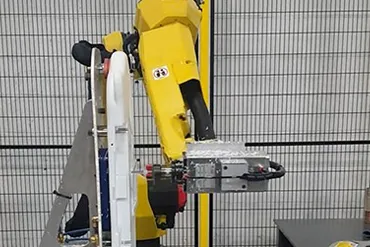
Latest Advancements in Material Cutting Robotics
Read about the latest technological advancements in robotic material cutting.
- Featured
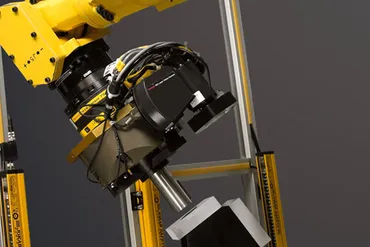
Emerging 3D Vision Technologies for Industrial Robots
Learn about the emerging 3D vision technology that businesses are using for industrial robot applications.
- Featured
Most Popular Industrial Robotic Applications for 2021 and Projections
Explore the most popular application trends of 2021 and what to expect in the future.
- Featured
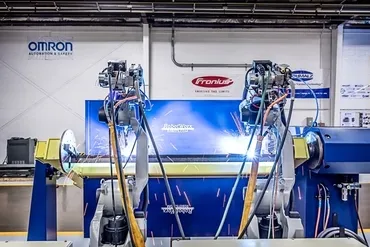
MAG Welding Defined
Automating your MAG welding process will help to bring faster and more consistent cycle times. A robotic MAG welder will also help to improve the weld quality, helping your customer's become more satisfied with the final product. If you are interested in integrating a new or refurbished robotic system, contact Robots.com experts today.
- Featured
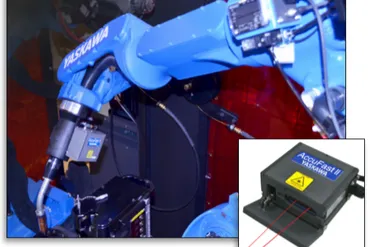
AccuFast II Tackles Seams Quickly and with Quality
Motoman provides users with add-on features to help enhance the seam finding for their automated welding line. AccuFast II offers improved sensor capabilities that provide even higher amounts of reliability. It provides more readings for a wider range of materials and angles not formerly feasible.
- Featured
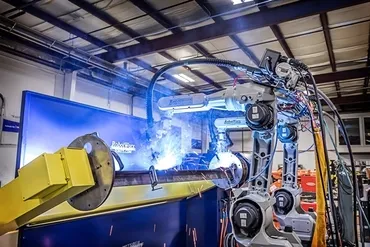
Flexible Manufacturing Lines
Each year the automation industry continues to innovate and bring solutions that will improve the productivity, flexibility, and efficiency on a wide range of production lines. This is seen with the flexible manufacturing that enables a robot to work on different types of products in the same workcell. Flexible manufacturing lines help to provide an increase in productivity and manufacturing volume.
Let's talk!
Request your quick quote today.