
How Toyota uses automation and industrial robots to improve processes
Toyota is using automation to help improve their production processes for many years. They have been providing greater speeds and increased efficiency in a variety of domains such as textile, machinery, and automobile. Integrating robots has also helped to decrease waste products, saving company time and money.

Since its commencement in 1926, Toyota has expanded its business domains to include textile machinery, automobiles, material handling equipment, electronics, and logistics solutions. To get there, Toyota adopted the concept of “lean manufacturing".
What is lean manufacturing?
Lean manufacturing emphasizes increasing value while decreasing waste. With lean manufacturing, the customer determines what is valuable, while waste is defined as anything that doesn't add value, such as overproduction, waiting, defective parts, etc. Toyota also strives to ensure their workers’ skills are not wasted, which would decrease their job satisfaction and their motivation, and therefore, their efficiency. Incorporating automation has ensured that the amount of waste has decreased significantly.
Manufacturing Robots
Toyota has been developing industrial robots since the 1970s and introducing them into their manufacturing systems to improve quality and reduce costs. Robots are primarily used in their welding, painting, and assembly processes. Toyota aims to combine industrial robot technologies with automobile control technologies and state-of-the-art IT technologies.
Many of the automated products Toyota develops are not immediately related to the automotive industry. In 2007, Toyota announced their vision of Toyota Partner Robot series to help support human life. The Care Assist robot and the Walk Assist Robot were developed to aid in healthcare, domestic duties, and personal transport. By 2012, Toyota was at work on the Human Support Robot to coexist with families to provide support and improve their quality of life.
Vehicle Automation
Of course, many of the automatic technologies Toyota uses are related to automobiles. The Toyota Motor Manufacturing plant brings together automatic guided tuggers and automatic guided carts to extend their lean manufacturing ideal. This efficient sub-assembly production system allows the automatic vehicles to be directed by a traffic control system that monitors the location of all of the vehicles in real time. Once products are delivered to a drop-off location, the parts feed robot processes in workstations. When they are finished, a robot loads a flow rack which is picked up for an AGC to be delivered to the next workstation to be installed into the body of a vehicle.
The Toyota Automated Guided Container Transport System automates transport work in storage yards and leverages the software technology to help optimize loading operations. It helps reduce idle time of cranes and container trailers, which increases productivity and ROI.
In 2013, Toyota developed a next-generation advanced driving support system entitled Automated Highway Driving Assist. AHDA uses automated driving technologies to support safer highway driving by linking cooperative-adaptive cruise control with lane trace control.
Why should you choose industrial robots?
As seen by Toyota's results, industrial robots can save time, money, materials, and space while also increasing production and product quality and providing a quick return on investment.
Our refurbished robots are also integration-ready, meaning they come ready to work, while at a fraction of the cost of a new robot.
Robot Integration with Robots.com
Robots.com works with companies like Toyota to provide the most efficient industrial robots for the best automation lines. If you are interested in buying an industrial robot, we carry a large variety including Fanuc, KUKA, Motoman, and ABB. Contact us today or at 877-762-6881.
Related Articles
You might be also interested in:
- Featured
Latest Advancements in Material Cutting Robotics
Read about the latest technological advancements in robotic material cutting.
- Featured
Emerging 3D Vision Technologies for Industrial Robots
Learn about the emerging 3D vision technology that businesses are using for industrial robot applications.
- Featured
Most Popular Industrial Robotic Applications for 2021 and Projections
Explore the most popular application trends of 2021 and what to expect in the future.
- Featured
MAG Welding Defined
Automating your MAG welding process will help to bring faster and more consistent cycle times. A robotic MAG welder will also help to improve the weld quality, helping your customer's become more satisfied with the final product. If you are interested in integrating a new or refurbished robotic system, contact Robots.com experts today.
- Featured
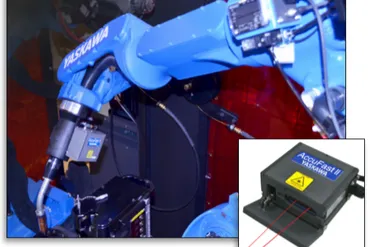
AccuFast II Tackles Seams Quickly and with Quality
Motoman provides users with add-on features to help enhance the seam finding for their automated welding line. AccuFast II offers improved sensor capabilities that provide even higher amounts of reliability. It provides more readings for a wider range of materials and angles not formerly feasible.
- Featured
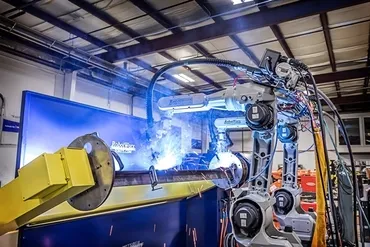
Flexible Manufacturing Lines
Each year the automation industry continues to innovate and bring solutions that will improve the productivity, flexibility, and efficiency on a wide range of production lines. This is seen with the flexible manufacturing that enables a robot to work on different types of products in the same workcell. Flexible manufacturing lines help to provide an increase in productivity and manufacturing volume.
Let's talk!
Request your quick quote today.