
Robot Palletizing vs Conventional Palletizing
Palletizing robotic systems come in a variety of shapes and sizes. Whatever your palletizing needs are, you can guarantee there is a robotic solution to get the job done quickly, consistently, and safely.

Palletizing equipment comes in many shapes and sizes. While there are many different palletizing equipment layouts, manufacturers really have to evaluate their processes to see if robotic palletizing will be more beneficial for your facility than manual palletizing.
Some important things to consider are:
- The size, weight and shape of your products
- The construction and stability of your products
- The secondary packaging involved
- Any pattern-forming capabilities available during production
Conventional palletizers can create a pattern when loading, but robots can make user-friendly loads. Robot palletizers can also handle difficult loads and high speeds of production.
Robot palletizers are great solutions for applications where the product demands precision. Bags and pails are perfect examples of this. The need to precisely place items like pails on pallets is necessary, for example, because pails need to be placed on top of each other in a very specific way, “nesting” on the lid of the pail below it.
Robot palletizers also have the ability to work in confined spaces or environments full of dust and other particles, which make them great for bag palletizing applications.
While robot palletizers can move up to 70 cases per minute, conventional palletizers can work at very high speeds, processing 200 cases per minute.
Since conventional palletizers never have to pick up a product, as opposed to just moving a product, they can handle several different types of products with little to no problem. Palletizing robots can also handle this type of versatility and flexibility if they have their end-of-arm-tooling switched to fit the product.
Conventional palletizing is best for high-speed applications that have reduced product packaging and complex pattern forming. Robotic palletizing is best when palletizing on a lower-speed, multi-line system, especially when handling bags, pails and other specific types of materials.
Manpower is also a factor when deciding between conventional and robotic palletizing. These machines are very different in their operation and maintenance needs. Manufacturers need to consider whether their staff would be able to learn the more complex robotic applications over the conventional applications.
Robots.com, a certified integrator of Motoman, KUKA, ABB, Universal Robots, and Fanuc robots, can work with customers who choose robotic palletizing for their facilities.
For more information about what Robots.com can do to help you automate your palletizing system, contact our sales department online or at 877-762-6881.
Related Articles
You might be also interested in:
- Featured
Latest Advancements in Material Cutting Robotics
Read about the latest technological advancements in robotic material cutting.
- Featured
Emerging 3D Vision Technologies for Industrial Robots
Learn about the emerging 3D vision technology that businesses are using for industrial robot applications.
- Featured
Most Popular Industrial Robotic Applications for 2021 and Projections
Explore the most popular application trends of 2021 and what to expect in the future.
- Featured
MAG Welding Defined
Automating your MAG welding process will help to bring faster and more consistent cycle times. A robotic MAG welder will also help to improve the weld quality, helping your customer's become more satisfied with the final product. If you are interested in integrating a new or refurbished robotic system, contact Robots.com experts today.
- Featured
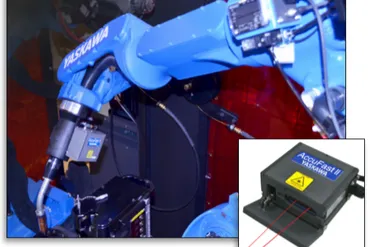
AccuFast II Tackles Seams Quickly and with Quality
Motoman provides users with add-on features to help enhance the seam finding for their automated welding line. AccuFast II offers improved sensor capabilities that provide even higher amounts of reliability. It provides more readings for a wider range of materials and angles not formerly feasible.
- Featured
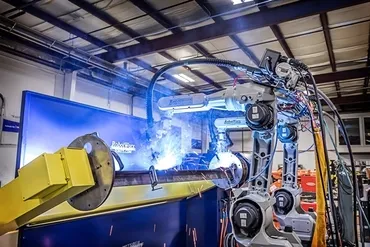
Flexible Manufacturing Lines
Each year the automation industry continues to innovate and bring solutions that will improve the productivity, flexibility, and efficiency on a wide range of production lines. This is seen with the flexible manufacturing that enables a robot to work on different types of products in the same workcell. Flexible manufacturing lines help to provide an increase in productivity and manufacturing volume.
Let's talk!
Request your quick quote today.