
TIG Welding Robots Boost Speed and Quality
Of the many different types of welding automations available, TIG welding is one of the most popular. TIG welding is protected in an inert gas environment and uses an electric arc between a tungsten electrode and the metal being welded. There are a variety of TIG welding robots available with the major manufacturers such as Fanuc, KUKA, and Motoman.

Robotic welding began in the 1980s and has steadily grown to become the dominant application for industrial robots. Of the many different welding processes, tungsten inert gas welding, or TIG welding, is the most common. TIG welding involves using an electric arc between a non-consumable tungsten electrode and the metal being welded, all while protected in an inert gas environment.
TIG welding robots have recently made great strides in control precision, repeatability, speed, and range of motion. These improvements allow unit costs to be kept low without sacrificing quality, which is key to thriving in the modern ultra-competitive marketplace.
Among the makers of robotic TIG welders, Fanuc Robotics, KUKA, and Motoman Robotics stand out as the industry leaders. All three companies have continually improved their offerings in the TIG welding robot market, leading to cutting-edge designs like the Fanuc Arc Mate 100i, the KUKA KR-6 and KR-16 L8-3, and the Motoman MA1400 and VA1400.
The Fanuc Arc Mate 100i TIG welding robot incorporates desirable features like a reduced wrist size to allow it to reach and weld more areas. It also features internal routing of electric cabling and gas lines inside the robot arm. The Arc Mate 100i’s patented TurboMove advanced servo controls allow it to move more quickly and smoothly to different areas of the product, further reducing product cycle time without sacrificing quality.
KUKA has also developed multiple options for TIG welding robots. Options range from the reliable yet compact and economical KR-5 ARC to the top-of-the-line KR-16 L8-3 ARC with outstanding .04mm repeatability and large 8kg payload capacity. The KR-16 L8-3 TIG welding robot also features a hollow-wrist design, allowing the TIG welding tooling to be housed inside the robot arm, protecting it from damage and reducing undesirable “whiplash” effects from the robot moving.
In the Motoman Robotics line of TIG robotic welders, the most notable are the MA1400 and VA1400 models. Like their competitors’ models, both of these Motoman TIG welding robots feature internal electrical cabling and gas lines as well as industry-leading payload and repeatability specs. However, only the VA1400 features a unique elbow-like joint, allowing 7-axis mobility as opposed to the 6 axes offered in all other competing TIG welding robots. The increased mobility of Motoman’s VA1400 welding robot allows it to reach more areas, reducing the number of robots needed to complete a specific TIG welding application.
For more information on TIG welding robots, different manufacturers, and specific models, click on the following links for Fanuc, KUKA, and Motoman TIG welding robots. If you have any questions about TIG Welding robotic integration, contact Robots.com online or at 877-762-6881.
Related Articles
You might be also interested in:
- Featured
Latest Advancements in Material Cutting Robotics
Read about the latest technological advancements in robotic material cutting.
- Featured
Emerging 3D Vision Technologies for Industrial Robots
Learn about the emerging 3D vision technology that businesses are using for industrial robot applications.
- Featured
Most Popular Industrial Robotic Applications for 2021 and Projections
Explore the most popular application trends of 2021 and what to expect in the future.
- Featured
MAG Welding Defined
Automating your MAG welding process will help to bring faster and more consistent cycle times. A robotic MAG welder will also help to improve the weld quality, helping your customer's become more satisfied with the final product. If you are interested in integrating a new or refurbished robotic system, contact Robots.com experts today.
- Featured
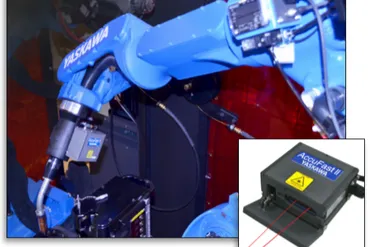
AccuFast II Tackles Seams Quickly and with Quality
Motoman provides users with add-on features to help enhance the seam finding for their automated welding line. AccuFast II offers improved sensor capabilities that provide even higher amounts of reliability. It provides more readings for a wider range of materials and angles not formerly feasible.
- Featured
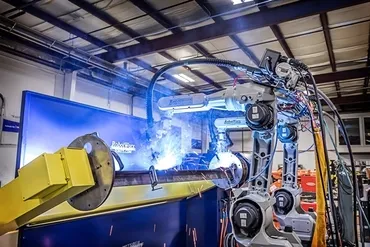
Flexible Manufacturing Lines
Each year the automation industry continues to innovate and bring solutions that will improve the productivity, flexibility, and efficiency on a wide range of production lines. This is seen with the flexible manufacturing that enables a robot to work on different types of products in the same workcell. Flexible manufacturing lines help to provide an increase in productivity and manufacturing volume.
Let's talk!
Request your quick quote today.